PSYCHIATRY / CLINICAL SKILLS / OSCE GUIDE
Mental State Examination (MSE) OSCE Guide: Questions, Examples & Checklist
How do you perform a Mental State Examination (MSE) in an OSCE—and present your findings confidently without confusing psychiatric terms or overlooking an immediate safety concern?
This is your complete Mental State Examination OSCE guide: a practical, clinically grounded resource that takes you from the first patient question to an accurate examiner presentation. You'll learn what to observe, what to ask, how to interpret the findings, and how to explain what you did—and did not—assess.
In this guide, you'll find:
- All eight MSE domains, with patient-friendly questions and accurate clinical terminology.
- Essential distinctions, including mood vs. affect, thought form vs. thought content, and hallucinations vs. intrusive thoughts.
- Five worked psychiatry OSCE cases and eight mistake-spotting exercises that turn knowledge into clinical decisions.
- An eight-minute station plan, a 60–90-second examiner presentation framework, university demonstration videos, and a printable two-page checklist.
Your goal by the end: conduct a focused MSE, recognize when to seek urgent senior help, and present the findings clearly without inventing normal results or jumping to a diagnosis.
Start the step-by-step guide Download the free MSE checklist (PDF)
Scope and clinical note: This resource focuses on general adult psychiatry OSCEs. Adapt your approach to children, older adults, neurodevelopmental, language and sensory needs, and the station instructions. It is educational material, not a replacement for supervision, local emergency procedures or applicable law. [18]
How to read the clinical highlights
Essential knowledgeDefinitions and reliable examination wording
Patient safetyUrgent concerns and cautions
Examiner insightHow to present and justify findings
On this pageJump to a section
The one-line MSE sequence: Appearance and behavior → Speech → Mood and affect → Thought form → Thought content → Perception → Cognition → Insight and judgment. Assess safety throughout, not only at the end. [1] [2] [3]
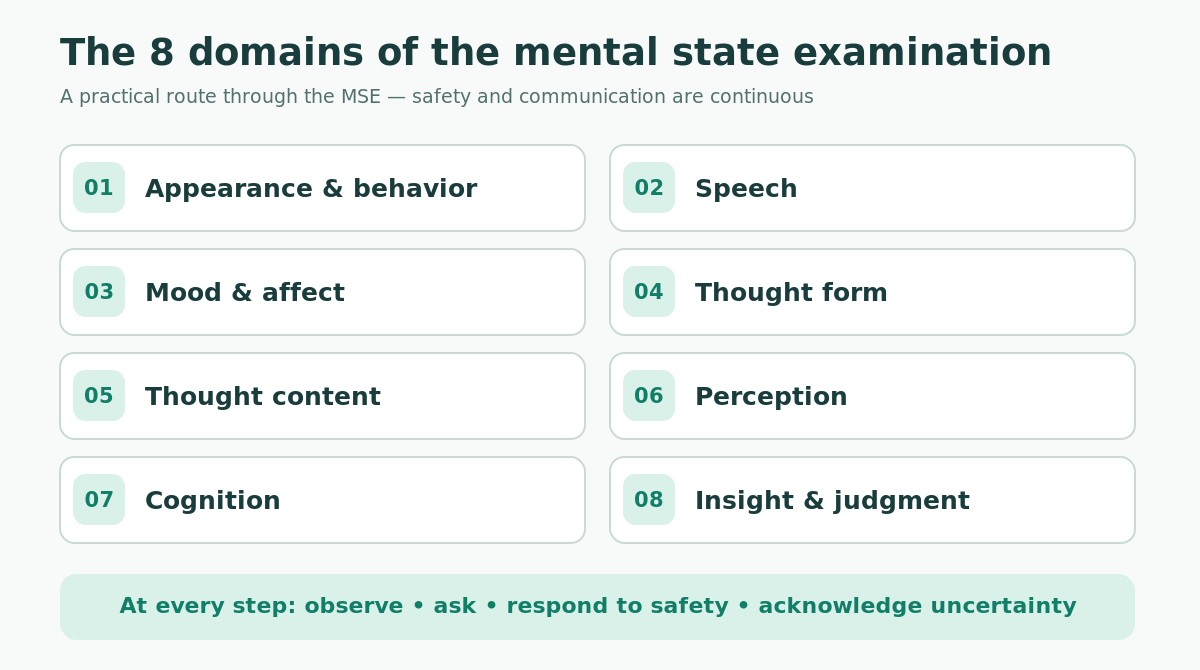
Figure 1. Original OSCE AI learning diagram. The eight headings help structure the examination; risk, medical causes and communication run throughout the encounter.
Quick answer: How do you perform a mental state examination in an OSCE?
In brief: In a mental state examination (MSE) OSCE, introduce yourself and establish rapport; observe appearance, behavior and speech; ask about mood, thoughts and perception; assess cognition, insight and judgment as indicated; and evaluate relevant safety concerns throughout. Finish by presenting what you observed, what the patient reported, what remains unassessed, and any urgent next steps.
- Introduce yourself, explain your role, obtain appropriate agreement and start with an open question.
- Observe from the outset: appearance, engagement, movement, speech and emotional expression.
- Elicit current experiences: subjective mood, relevant beliefs and preoccupations, perceptual experiences and symptoms indicating immediate danger.
- Test cognition selectively according to the presentation and station instructions; do not assume cognition is normal just because the patient is oriented.
- Explore insight and decision-making without assuming disagreement means incapacity.
- Present what was observed, what was reported, what was not assessed, and what should happen next.
| Domain | What the examiner wants to hear | Where the evidence comes from |
|---|---|---|
| Appearance and behavior | Dress, self-care, engagement, psychomotor activity, observable movement | Mostly observation |
| Speech | Rate, quantity, volume, latency, fluency, pressure and articulation | Listening |
| Mood | Patient's subjective emotional state | Asking the patient |
| Affect | Observed emotional tone, range, intensity, reactivity, congruence | Observation |
| Thought form | Organization and associations in the person's replies | Listening to responses |
| Thought content | Preoccupations, obsessions, unusual beliefs, thoughts of harm | Focused questions |
| Perception | Hallucination-like experiences, illusions, dissociation | Focused questions |
| Cognition | Consciousness, attention, orientation, memory and relevant functions | Observation plus appropriate testing |
| Insight and judgment | Understanding of experiences, help-seeking and real-world decisions | Interview and collateral information if available |
Remember: there is no globally mandated order or single universal OSCE mark scheme. Follow your station brief. [1] [2] [3] [4]
Mental state examination OSCE questions: what should you ask?
Not every MSE domain requires a question. Appearance, speech, affect and much of thought form are assessed primarily through observation. Use the examples below selectively, according to the station and the patient's needs.
| Domain | Question or observation |
|---|---|
| Appearance and behavior | Observe dress, grooming, engagement, motor activity and responses; do not infer a diagnosis from appearance. |
| Speech and thought form | Listen during open questions: is speech pressured or reduced, and do the person's ideas connect coherently? |
| Mood | “How have you been feeling in yourself today?” |
| Thought content | “Is there anything that's been worrying you or occupying your thoughts?” Follow up sensitively when indicated. |
| Perception | “Have you been hearing or seeing things that other people don't seem to notice?” Characterize any reported experience. |
| Cognition | “Could you tell me where we are?” Consider attention and other tests if clinically relevant; orientation alone is insufficient. |
| Insight | “What do you think might explain what you've been experiencing?” |
| Safety | When indicated, ask directly: “Have you had thoughts about ending your life?” Explore immediate concerns and act appropriately. |
For a printable revision aid, use the free mental state examination OSCE PDF checklist. The full domain sections below explain how to interpret answers and avoid common mistakes.
1. What is the MSE—and what is it not?
The MSE (also called the mental status examination in many US curricula) is a cross-sectional description of a person's mental functioning at the time of assessment. You obtain it through observation, conversation and, where indicated, formal cognitive tasks. It helps clinicians describe phenomena, formulate differential diagnoses, establish immediate priorities and document change over time. It rarely establishes a diagnosis by itself. [1] [2] [3]
| Assessment | Main question | Example |
|---|---|---|
| Psychiatric history | What has been happening over time? | “When did these symptoms begin, and how have they changed?” |
| MSE | What is the person's mental state during this encounter? | “Speech was pressured; affect was elevated and labile.” |
| Physical assessment | Might a physical condition, medicine or substance contribute? | Vital signs, neurological signs and relevant investigations |
| Cognitive screen, e.g. MMSE or MoCA | How does the person perform on specified cognitive tasks? | Attention, memory and orientation items |
MSE is not MMSE. The Mini-Mental State Examination is one cognitive screening instrument. It does not replace the full mental state examination, and it should not be performed routinely in every psychiatry OSCE.
A patient's description of how they felt last month belongs principally in the history; their current account of feeling frightened or low can be included in the MSE. Make the timeframe clear.
Related OSCE skills: For a broader station structure, see the OSCE template for history, examination and communication stations. To explore additional clinical guides, visit the OSCE AI resources hub.
2. What do examiners expect?
Most MSE stations evaluate four competencies: (1) systematic and appropriate observation and questioning; (2) rapport, clarity, empathy and professional behavior; (3) accurate description and interpretation; and (4) recognition and response to safety or medical concerns. The exact weightings depend on your institution.
Three common station types are perform an MSE, take a focused psychiatric history and present the MSE, and interpret an MSE vignette or video. Do not spend the entire station taking a longitudinal history when the task is a focused MSE; do not omit history when the station explicitly requests it.
| Basic candidate response | More clinically useful response |
|---|---|
| “The patient hears voices.” | “They report an unfamiliar voice, mainly in the evening; I would clarify its phenomenology, distress, any instructions and implications for safety.” |
| “Mood and affect are low.” | “The patient describes low mood; observed affect is predominantly sad, restricted but reactive.” |
| “Cognition is fine.” | “Alert and oriented to place and approximate date; attention and memory were not formally tested.” |
| “No suicide risk: there is no plan.” | “The patient denies a current plan; I still need to clarify intent, past behavior, circumstances, protective factors and immediate safety needs.” |
3. Opening the consultation: words you can use
Before beginning, check privacy, immediate safety and accessibility. Introduce yourself accurately as a medical student—not a qualified psychiatrist. Confirm the patient's identity appropriately and explain the purpose of the discussion.
“Hello, I'm one of the medical students working with the team. I'd like to understand how you've been feeling and what you've been experiencing. Some questions may feel personal, and we can take them at your pace. Is that okay?”
Then use an open prompt: “What has been most difficult for you recently?” or “Could you tell me what brought you here?”
Confidentiality: Do not promise absolute secrecy. Explain that information is handled within the care team and that serious safety concerns may require appropriate sharing according to law and policy. [5]
If the patient hesitates: “Would you prefer to start with what has been troubling you most?” Offer appropriate choice and time. If the patient refuses: respect the situation, assess immediate safety, describe the limits of the encounter and seek supervision if necessary. If the patient is agitated: do not confront, crowd or block their exit; follow local de-escalation and safety arrangements. If language or hearing is a barrier: arrange suitable communication support rather than interpreting unclear speech or responses as psychopathology.
Observe from the first greeting: dress, self-care, manner, response latency, speech, activity, attention, and affect. Observation is continuous; the patient does not need to know which heading you are mentally ticking off.
4. The eight MSE domains: detailed examination and exact questions
4.1 Appearance, behavior and psychomotor activity
Describe what you actually see, rather than guessing a diagnosis or personality. Observe clothing in context, hygiene, posture, facial expression, engagement, eye contact in context, psychomotor activity and any abnormal movements.
| Finding | What it means or what to clarify |
|---|---|
| Psychomotor agitation | Increased restless activity: pacing, fidgeting or inability to remain seated; examine context |
| Psychomotor retardation | Observable slowing of movement, gestures and responses |
| Akathisia | Subjective inner restlessness, often with observable movement; consider medication exposure |
| Tremor | Rhythmic involuntary movement; consider drug effects and medical causes |
| Tardive dyskinesia | Repetitive involuntary movements, often orofacial; consider dopamine-receptor-blocking drug exposure |
| Catatonic features | Signs such as stupor, mutism, posturing, negativism or waxy flexibility; urgent clinical assessment may be indicated |
Poor description: “The patient was aggressive.” Better: “They repeatedly raised their voice and stood up abruptly when admission was discussed.”
Avoid assumptions. Clothing, reduced eye contact or distinctive movement can reflect culture, poverty, disability, neurodevelopment, medication effects or the individual's baseline—not necessarily illness.
Safety warning: Profound immobility, poor intake, suspected catatonia, severe agitation or abnormal vital signs are reasons to stop treating the encounter as a routine checklist and obtain urgent clinical support. [12]
Watch and describe: The University of Toronto's observable anxiety demonstration is a useful prompt. Describe the visible behaviors before choosing a diagnostic explanation. [16]
4.2 Speech and language
Speech is assessed mainly by listening. Record features that are supported by the encounter.
| Feature | Descriptors or examples |
|---|---|
| Rate | Slow, ordinary, rapid |
| Volume | Quiet, ordinary, loud |
| Quantity | Reduced, spontaneous, excessive |
| Pressure | Driven, difficult to interrupt |
| Response latency | Time taken before answering |
| Prosody | Typical variation, monotonous or unusually variable |
| Fluency/articulation | Fluent, hesitant, stammering, dysarthric; investigate language deficits when indicated |
| Mutism | Little or no speech; requires assessment of alternative explanations |
“Speech was rapid and difficult to interrupt, with increased quantity” is clearer than “speech manic.” “Speech was soft, sparse and delayed” is clearer than “speech depressed.”
Do not confuse speech with thought form. A person can speak quickly but remain coherent; another may speak at an ordinary rate while displaying derailment.
Watch and describe: University of Toronto: monotonous speech. Observe rate, volume, prosody and the amount spoken. [16]
4.3 Mood and affect
Mood is what the person reports feeling; affect is the emotional expression you observe. Both matter, and they may not match. [1] [2] [3]
Ask: “How would you describe your mood today?” Follow with “Has that changed recently?” If appropriate, explore sadness, anxiety, irritability, elevated mood, numbness, pleasure, energy and sleep. Sleep and energy are also important history items; note what timeframe they refer to.
For affect, describe predominant quality, range, intensity, stability, reactivity and congruence where observed.
| Affect term | Practical observation |
|---|---|
| Full range | Displays a varied emotional response appropriate to the conversation |
| Restricted | Narrower-than-expected range of expression |
| Blunted | Markedly reduced intensity of emotional expression |
| Flat | Very little observable emotional expression |
| Labile | Rapid or pronounced changes in expressed emotion |
| Reactive | Expression changes in response to the subject or interaction |
| Incongruent | Expression is inconsistent with reported mood or conversational context |
Worked example: Patient: “I'm fine, everything is wonderful.” During discussion of a recent loss, they become tearful and tense. Document: “They describe their mood as positive; affect was anxious and tearful during the discussion, with incongruence between self-report and observed expression.” Do not infer dishonesty.
A subtle distinction: A patient may report three weeks of pervasive low mood yet smile appropriately in response to a warm comment. That does not invalidate the mood report; their affect may be sad but reactive.
University demonstrations: Compare flat affect, elevated affect and labile affect from the University of Toronto. Pause after each and describe the observed behavior without first using the video's label. [16]
4.4 Thought form: how thoughts are organized
Thought form, also called thought process, concerns the organization, connections and progression of ideas—not the beliefs themselves. It is principally inferred from the person's speech during the interview. [2] [3]
| Term | How to recognize it | Caution |
|---|---|---|
| Goal-directed/coherent | Understandable answers that reach the point | Do not automatically assume all domains normal |
| Circumstantial | Excessive side details but eventually answers | Long speech alone is not enough |
| Tangential | Shifts away and does not return to the question | Consider anxiety, language and interview context |
| Flight of ideas | Rapid changes linked by recognisable, often superficial associations | Rapid speech alone does not establish it |
| Derailment/loosening | Associations become difficult to follow | Require sufficient examples, not one eccentric phrase |
| Thought blocking | A sudden interruption in the apparent train of thought | May also reflect distraction, anxiety or neurological causes |
| Perseveration | Inappropriate repetition of a response or idea | Not the same as recurrent depressive rumination |
| Clang association | Connections driven by word sound or rhyme | Consider language and cultural variation |
| Neologism | Idiosyncratic word formation | Do not mistake unfamiliar vocabulary for pathology |
Test yourself — same question, different answer: “Why did you come to hospital?”
A. “I woke up late, then the bus didn't come, and I went to my sister's house, which reminded me of last year's holiday. Anyway, my sister eventually drove me because I had become frightened by voices.”
B. “Hospitals are terribly expensive. I used to run a restaurant, and we always had trouble with food costs. Food prices are still increasing, and I could explain our old recipes for hours.”
C. “I had to come because I have a big plan: a business plan, then planes—airplanes, worldwide travel! Travel is freedom, freedom means no limits, and I'm buying six companies tomorrow!”
D. “I heard the voices last night. I was going to explain what they said, and then…” [A prolonged abrupt pause; the patient reports that their thought has vanished.]
Interpretation: A is circumstantial (eventually answers); B is tangential (does not return); C may suggest flight of ideas if rapid, pressured delivery and superficial but traceable associations are actually observed; D may suggest thought blocking, subject to further assessment. This is an illustrative teaching construction—not a diagnosis from one sentence.
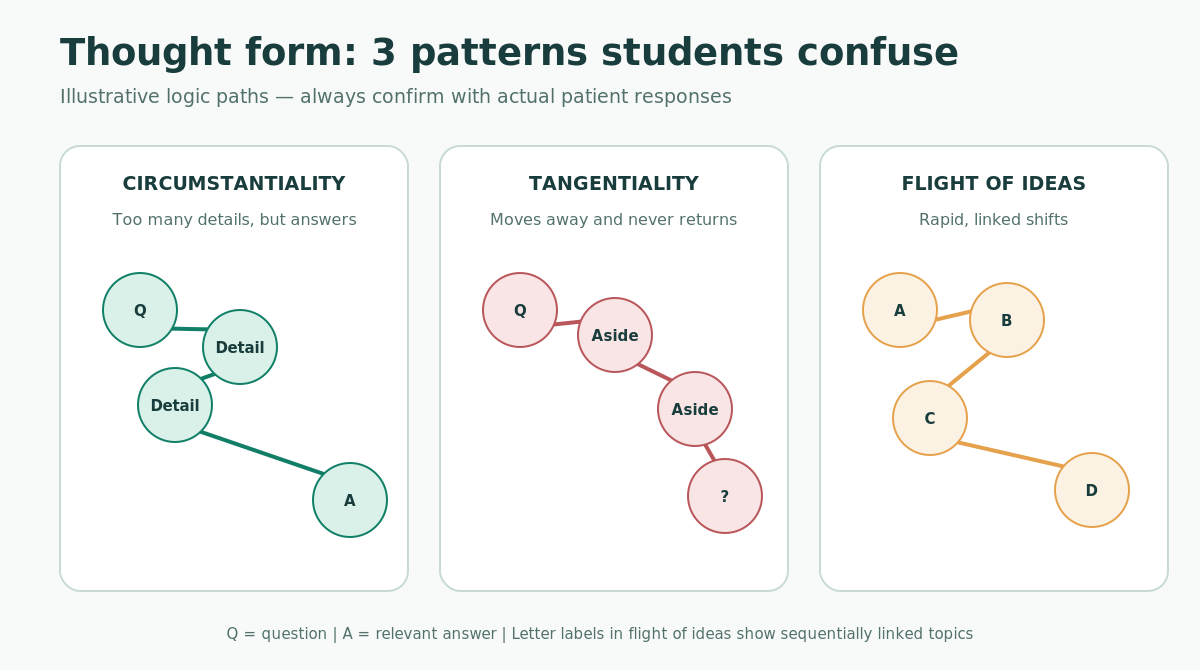
Figure 2. Original OSCE AI learning diagram: reach the answer, leave the answer, or move rapidly through linked ideas.
4.5 Thought content: what the person is thinking about
Thought content concerns themes, preoccupations and beliefs, including hopelessness, guilt, worthlessness, rumination, obsessions, suicidal thoughts, thoughts of harming others and possible delusions.
Ask open questions first: “What's been most on your mind?” For possible persecutory ideas: “Have you felt watched, threatened or unsafe?” Follow up without confrontation:
- “Could you tell me what led you to that conclusion?”
- “How certain are you? Have there been times you felt less certain?”
- “How has this affected what you do?”
- “Have you felt you needed to protect yourself or someone else?”
Delusion: a firmly held belief that is not readily changed by contrary evidence and is not adequately understood within the person's cultural or social context. A surprising belief is not automatically a delusion. Overvalued idea: an unusually dominant, strongly held idea that may be understandable in context; boundaries can be complex. Obsession: a recurrent intrusive thought, image or urge, often unwanted and distressing; insight varies. Compulsion: a repetitive behavior or mental act often performed in response to an obsession or rigid rule. [2] [3]
High-yield contrast: “An unwanted thought flashed through my mind that I might hurt someone, and it horrified me” is not equivalent to “I intend to hurt that person.” Clarify experience, intent, control, associated behavior and safety—without dismissing either account.
Know the classic thought-experience descriptions: thought insertion (thoughts experienced as externally placed), thought withdrawal (thoughts experienced as removed) and thought broadcasting (belief that thoughts are accessible to others). These may be relevant to psychosis assessment but are not individually diagnostic of schizophrenia.
University demonstrations: Grandiose delusions and persecutory delusions on the University of Toronto teaching page. [16]
4.6 Perception and related experiences
A hallucination is a perception-like experience without the corresponding external stimulus; an illusion is a misinterpretation of an actual stimulus (for example, mistaking a coat shadow for a person). Auditory, visual, tactile, olfactory and gustatory experiences may occur in psychiatric, neurological, medical, substance-related and sleep-related contexts. [1] [2] [3]
Begin gently: “Some people experience sounds, voices or images that others don't seem to notice. Has anything like that happened to you?”
If voices are described, characterize their quality, frequency, location or perceived source, content, distress, insight, effect on behavior and any instructions. Consider sleep transitions, medication, substances, hearing, neurological symptoms and cultural meaning. Voices apparently experienced “inside the head” should not automatically be relabelled as ordinary thoughts.
Important distinctions:
| Patient's words | What to explore before naming the phenomenon |
|---|---|
| “My own thoughts keep telling me I'm useless.” | Intrusive/automatic thought or another experience? |
| “I hear an unfamiliar voice criticising me when nobody speaks.” | Auditory hallucination-like experience: phenomenology and context |
| “The coat looked like a person until I turned the light on.” | Illusion |
| “Everything around me feels unreal.” | Derealisation |
| “I feel detached from myself, as if watching from outside.” | Depersonalization |
Command experiences: If voices instruct harm, ask about the command, intent to comply, previous compliance, access to means, distress and immediate context. A command is a safety signal, not a prediction of compliance. Respond according to the whole assessment.
Watch and describe: University of Toronto: perception demonstration. [16]
4.7 Cognition: what has—and has not—been tested?
Cognition includes level of consciousness, attention, orientation, memory, language and, when relevant, executive and visuospatial functions. A quick MSE may not formally test all of them.
| Domain | Example assessment | Documentation caution |
|---|---|---|
| Consciousness | Observe alertness and responsiveness | Note drowsiness or fluctuation |
| Orientation | Ask date/place and, when relevant, situation | Orientation is not a complete cognitive screen |
| Attention | Months of the year backward or another suitable task | Interpret in language, educational and sensory context |
| Registration | Repeat a short set of words | Record task actually used |
| Delayed recall | Recall those words after a suitable delay | Do not equate one result with a diagnosis |
| Language | Assess naming, comprehension or expression if indicated | Separate language impairment from thought disorder |
| Executive/visuospatial | Relevant validated or bedside tasks if needed | Say when not tested |
Accurate: “Alert and oriented to place and approximate date; the months-backward task was not attempted. Memory and executive function were not formally tested.” Inaccurate: “Cognition intact.”
Delirium red flag: A recent or fluctuating disturbance of attention/awareness, particularly with medical illness or altered consciousness, needs urgent consideration of delirium and physical causes. In relevant hospital and long-term care populations, NICE CG103 recommends 4AT assessment when indicators of delirium are identified; critical care and recovery settings use different recommended instruments. [7]
Never continue a routine psychiatry OSCE while ignoring suspected acute medical deterioration.
4.8 Insight, judgment and decision-making capacity
Insight refers to the person's understanding of their experiences, possible explanations, and help needs. Ask: “What do you think is happening?”, “How do you understand these experiences?” and “What kind of help do you think might be useful?” Insight is not simply an all-or-nothing label.
Judgment concerns decisions and conduct in context: what the person has done, what consequences they anticipated, and what options they understand. Base conclusions on actual examples when possible; hypothetical “What would you do if…?” questions are only one possible approach.
Capacity is a separate, decision- and time-specific assessment. In England and Wales, the Mental Capacity Act framework considers whether the individual can understand, retain, use or weigh relevant information and communicate a decision, with support as appropriate. Disagreement, mental illness or an unwise decision does not automatically demonstrate incapacity. Other jurisdictions differ. [8]
Useful documentation: “The patient recognizes hearing voices and is willing to discuss support, but does not currently believe that they indicate a health problem. Capacity regarding the proposed decision has not been formally assessed.”
5. Safety assessment: an essential parallel task
Safety is not a ninth heading to complete after everything else. Ask relevant questions when the clinical picture warrants them; respond promptly when serious concerns emerge. The MSE informs a broader safety assessment that also includes history, circumstances, medical health, collateral information when appropriate, and evolving needs. [9] [20]
Asking about suicide and self-harm
You can ask directly and compassionately:
“When things have been very difficult, have you wished you wouldn't wake up?”
“Have you had thoughts of ending your life or harming yourself?”
If the person reports thoughts of suicide or self-harm, clarify current thoughts, intent, any planning or preparation, access to means, past actions, changes over time, acute distress, substance use, supports and what may help keep them safe. Ask about the person's own wishes and immediate needs. A person can have serious safety needs without reporting a specific plan.
Differentiate suicidal intention, nonsuicidal self-injury, and unwanted intrusive thoughts. Never assume they are equivalent; never dismiss any significant disclosure.
Broader safety concerns
Where clinically relevant, consider violence or fear-driven defensive behavior, severe self-neglect, impaired eating or drinking, inability to care for essential needs, exploitation or abuse, vulnerability, intoxication or withdrawal, and medical deterioration. Ask about access to weapons or other dangerous means only when relevant, neutrally and without assuming intent.
What should you do if the answer is concerning?
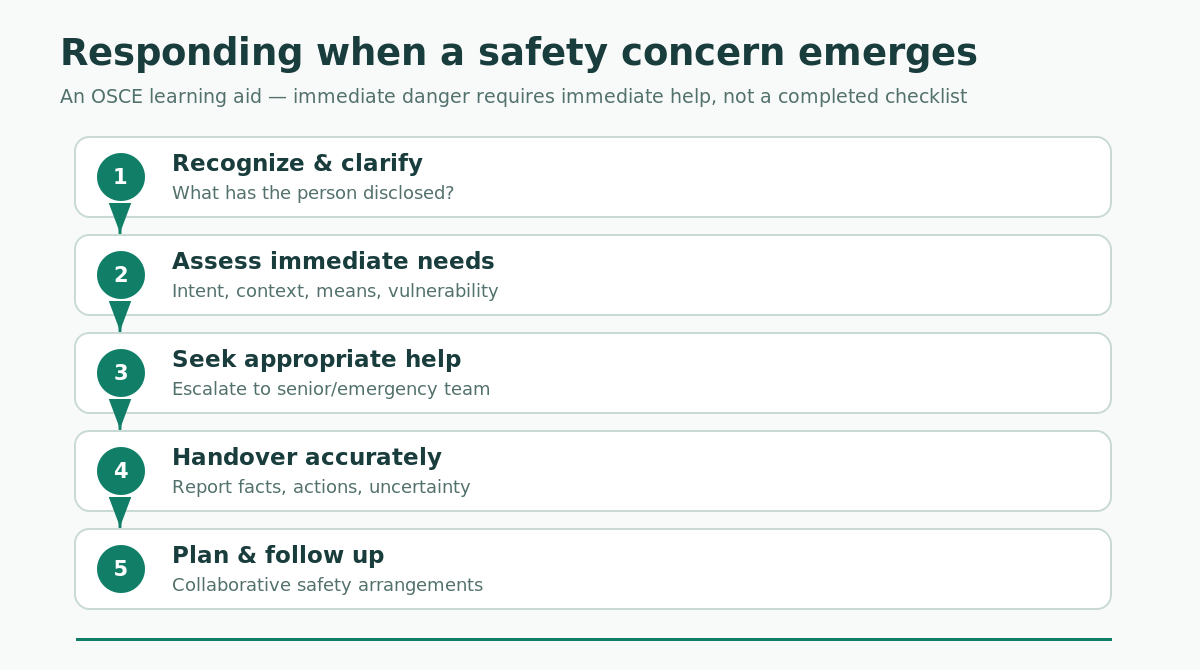
Figure 3. Original OSCE AI educational pathway. In an actual emergency, summon help immediately according to local procedures rather than waiting to finish a screening sequence.
- Acknowledge and clarify the concern without expressing blame or minimizing it.
- Determine immediate needs and danger through appropriate focused assessment.
- Obtain urgent senior or emergency help when indicated; do not leave a person facing an immediate safety emergency without appropriate clinical arrangements.
- Communicate a factual handover covering what was said, actions taken and outstanding uncertainties.
- Collaborate on appropriate safety planning and follow-up under clinical supervision, where feasible.
NICE NG225 advises against using risk scores or low/medium/high categories to predict suicide or future self-harm, or to decide treatment or discharge on that basis. It favors individualised psychosocial assessment and formulation. This does not mean that a clinician should avoid structured clinical inquiry. [9] NHS England's updated safety-assessment guidance also emphasises collaborative formulation and management planning. [20]
Good OSCE statement: “I am concerned about immediate safety. I would involve my supervising clinician now, ensure the patient receives appropriate support and assessment, and would not make a disposition decision on the basis of this brief MSE.”
6. Physical causes and urgent differentials: do not miss them
The psychiatric MSE does not replace a physical examination. Consider medical, neurological, substance-related, medication-related and withdrawal causes when symptoms are new, atypical, rapidly changing or accompanied by abnormal physical findings. First-episode psychosis requires a comprehensive assessment including physical and social factors. [10]
| What you find | What else must be considered |
|---|---|
| Acute fluctuating confusion and impaired attention | Delirium, infection, metabolic disorders, drug or withdrawal effects |
| New neurological deficits, seizures or unusual headache | Neurological/medical illness |
| Tremor, slowed thinking or ataxia during lithium treatment | Adverse effects or possible lithium toxicity; urgent assessment if concerning |
| Fever, rigidity, autonomic disturbance or altered consciousness | Serious medical or medication-related syndromes requiring urgent evaluation |
| Marked immobility, mutism, poor intake or abnormal motor signs | Possible catatonia, medical causes and associated complications |
| New psychotic symptoms in the context of substance exposure | Substance/medication-induced or other causes |
Explain which vital signs, examination findings, medication reviews and targeted tests you would consider and why; do not order every test reflexively. For associated neurological examination skills, use OSCE AI's Neurological Examination OSCE Guide.
Lithium deserves specific caution: Tremor, ataxia and cognitive impairment need clinical assessment, including possible neurotoxicity even when serum levels are within a therapeutic range, as NICE CG185 notes. [11]
7. From description to clinical reasoning
Describe first. Interpret second. Diagnose only when the evidence supports it. A phenomenon seldom points to one disorder on its own.
| Pattern | Differential considerations | Essential missing information |
|---|---|---|
| Low mood, diminished speech and slowing | Depressive syndrome, medication effect, neurological or systemic illness | Duration, associated symptoms, functioning, substances, safety |
| Elevated/irritable mood, pressured speech and reduced sleep need | Mania, hypomania, substance/medication effect and medical causes | Duration, impairment, activity, previous episodes, collateral, safety |
| Persecutory beliefs and voices | Psychotic disorder, mood disorder with psychosis, substance or medical cause | Phenomenology, timeline, mood, attention, physical assessment, safety |
| Acute inattention and fluctuating consciousness | Delirium or another acute medical process | Baseline function, onset, vitals, medications, investigations |
| Restricted affect, reduced expression | Depression, negative symptoms, medication effects, neurological disease, personal baseline | History, medication and baseline context |
Three clinical reasoning mini-cases
A. Possible depression. A patient reports two weeks of low mood, has soft speech and appears slowed. You can describe those MSE findings, but should clarify past episodes, sleep, energy, appetite, possible medical contributors, functional impairment and suicidal thinking before concluding that a depressive disorder explains everything. NICE NG222 supports an assessment that considers severity, needs and personal context. [19]
B. Possible mania. A patient has pressured speech, elevated affect and describes sleeping two hours without feeling tired. This raises concern for mania, but you need duration, increased activity, impairment, prior episodes, medication/substance exposure and immediate safety information. Reduced need for sleep is different from wanting to sleep but being unable to.
C. Possible delirium. An older adult becomes disoriented over a few hours, repeatedly loses track of questions and appears more confused in the evening. Do not label their unusual statements a primary psychotic disorder without first evaluating acute medical and delirium explanations. [7]
8. Common MSE practice mistakes: can you spot the error?
Evidence note. The original OSCE AI manuscript describes an exploratory review of 51 de-identified AI–user practice conversations, including 10 psychiatry-related discussions across six distinct user IDs. The source transcripts, consent/authorization documentation and error-coding audit trail were not supplied for independent verification in this editorial revision. The exercises below are illustrative reconstructions of the educational problems described in that manuscript, not verbatim learner quotations, verified prevalence estimates or proof of general student behavior. If an internal evidence audit cannot substantiate the original-data claims, publish this section as common simulated MSE pitfalls rather than findings from our users.
Mistake 1: Putting flight of ideas under thought content
Challenge: A learner reports, “Thought content: flight of ideas and grandiosity.” What is misplaced?
Correction: Flight of ideas is a possible thought-form abnormality; grandiose beliefs belong under thought content. Also, rapid speech by itself does not justify flight of ideas.
Model wording: “Speech was rapid and difficult to interrupt. Thought form showed rapidly shifting, traceable associations suggesting flight of ideas. Thought content included grandiose beliefs.”
Repeat-practice target: Separately describe speech, thought form and thought content in three different simulated encounters.
Mistake 2: Treating the patient's stated mood as their affect
Challenge: A patient says, “I'm absolutely fine,” but is visibly tearful. A learner writes “mood and affect normal.”
Correction: Record reported mood and observed affect independently. Explore the discrepancy rather than assuming dishonesty.
Model wording: “Reported mood was ‘fine’; affect appeared predominantly sad and tearful during discussion of recent events.”
Repeat-practice target: Describe mood and affect in two contrasting videos without assigning a diagnosis.
Mistake 3: Declaring cognition normal after checking orientation
Challenge: The learner asks where the person is and the date, then reports “cognition intact.”
Correction: Only orientation was explored, and perhaps alertness was observed. Attention, memory and other domains remain untested.
Model wording: “Alert and oriented to place and date; attention and memory were not formally assessed.”
Repeat-practice target: Present an honest MSE with at least two explicitly unassessed domains.
Mistake 4: Minimizing suicidal thoughts
Challenge: A patient reports wishing they would not wake up. The learner writes “only passive thoughts, therefore safe.”
Correction: The wording does not establish the person's needs or immediate safety. Explore intent, changes, past behavior, circumstances and supports; formulate the next action.
Model response: “Thank you for telling me. I'd like to understand these thoughts better and what might help keep you safe.”
Repeat-practice target: Give a factual verbal handover without a numerical or global risk label. [9]
Mistake 5: Offering certainty to someone frightened by a possible persecutory belief
Challenge: “You are completely safe; no one could possibly harm you.”
Correction: The clinician cannot guarantee that. Acknowledge fear without affirming an unverified belief or promising absolute safety.
Better: “That sounds frightening. I'd like to understand what has been happening and discuss how we can help you feel safer.”
Repeat-practice target: Validate emotion, explore the belief and assess behavior in one response.
Mistake 6: Making an unsupported statement about surveillance or recording
Challenge: A frightened patient asks if the interview is being recorded. The learner replies, “There are definitely no cameras anywhere.”
Correction: Only state verified facts. Explain the actual local arrangements or say you will check. Unsupported reassurance may undermine trust.
Better: “That's an important question. I can explain what I know about this room and check anything I'm not sure about.”
Repeat-practice target: Give two versions of an accurate, transparent answer—one when recording is definitely prohibited, one when the arrangements need verification.
Mistake 7: Dismissing possible lithium adverse effects
Challenge: A patient on lithium reports worsening tremor and unsteadiness. The learner says, “Lithium doesn't do that.”
Correction: Tremor and possible neurological adverse effects require attention; unsteadiness or additional concerning symptoms could signal toxicity. Do not dismiss or independently change therapy.
Better: “Thank you for explaining. When did this begin, have symptoms changed, and are you feeling unsteady or unwell? I would arrange prompt senior assessment and appropriate medication and physical-health review.” [11]
Repeat-practice target: Combine empathic acknowledgement, medical assessment and safe escalation.
Mistake 8: Confusing intrusive thoughts with intent to harm
Challenge: A patient describes unwanted images of injuring a family member, becomes distressed and says they never want to act on them. The learner immediately labels this “violent intent.”
Correction: Explore whether the experience is unwanted and ego-dystonic, any associated compulsions, intention, behavior and context. Intrusive thoughts do not automatically establish intent, but relevant safety concerns should still be assessed.
Repeat-practice target: Write a descriptive thought-content note without prematurely assigning a diagnosis or intent.
Practice principle: For each error, write down (1) the observation, (2) the unsupported inference, (3) the clinically accurate wording and (4) the next question or action. This is more useful than memorising a corrected phrase without understanding it. Instructional-design research supports worked examples, authentic cases and targeted feedback in MSE education. [13] [14] [21]
9. Fully worked psychiatry OSCE cases
These are fictional educational cases, designed so that every positive MSE finding in each model summary is explicitly established in the case. Statements not supported by the vignette are marked as requiring further assessment.
Case 1. Possible first-episode psychosis: eight-minute focused MSE
Candidate instructions: You are a medical student in an emergency assessment unit. A 25-year-old patient has been brought by a family member following a recent change in behavior. Conduct a focused MSE, attend to immediate safety and present your findings.
Observed: The patient sits close to the door, looks around repeatedly, speaks at a normal rate and in comprehensible sentences, and is visibly tense but willing to answer questions.
Patient responses, if asked:
- Mood: “Mostly frightened.”
- Thought content: “Someone has been monitoring my phone for the past week. I am completely sure. I have kept a knife beside my bed in case they come in.”
- Perception: “Sometimes an unfamiliar male voice says, ‘Watch out.’ I hear it when nobody is in the room. It has never told me to hurt anybody.”
- Safety: “I haven't wanted to end my life and haven't planned to attack anybody. I'm scared and might defend myself if someone breaks in.” A fuller safety assessment is still required.
- Cognition: The patient is alert, names the hospital and identifies the month correctly. Months backward and formal memory testing are not performed.
- Insight: “I'm not ill. I just need someone to stop them watching me.”
- History: This has happened only recently according to the family member, but previous episodes, substance use, mood symptoms and medical causes have not yet been fully assessed.
Model examiner presentation:
“The patient appeared anxious and guarded, repeatedly glancing toward the door but remaining engaged. Speech was normal in apparent rate and quantity; answers were coherent, with no clear formal thought disorder observed. They described feeling frightened, and affect appeared anxious and congruent with the discussion. Thought content included a strongly held persecutory belief about phone surveillance. They reported hearing an unfamiliar warning voice when nobody was present; the experience needs further phenomenological characterization. They were alert and oriented to place and month, but attention and memory were not formally tested. Insight into a possible mental health explanation appeared limited. Of immediate concern, they reported keeping a knife by their bed because they felt threatened. Although they denied current suicidal thoughts and plans to attack someone, this warrants urgent senior review and a more complete safety assessment. This may represent a recent-onset psychotic presentation; I would also consider mood, substance-related, neurological and other medical causes before concluding that this is a first-episode psychotic disorder.”
Why this earns credit: It distinguishes reported experiences from observable features; does not claim all cognition is normal; treats the knife disclosure as urgent without automatically assigning violent intent; and avoids diagnosing schizophrenia from one encounter. [10]
Case 2. Depression: report mood, affect and immediate safety honestly
Observed: A 39-year-old patient is neatly but simply dressed. They sit with reduced spontaneous movement, speak softly with prolonged response latency and become tearful while discussing work.
Patient report: “I've felt down nearly every day for three weeks.” They describe loss of pleasure, poor sleep and feelings of worthlessness. Asked directly, they report wishing not to wake up on some mornings, but deny a current suicide plan. The learner has not yet established intent, previous self-harm, access to means or immediate supports.
Model summary:
“The patient was appropriately dressed, with reduced spontaneous activity and slowed, quiet speech. They reported persistently low mood over three weeks; observed affect was sad, restricted and at times tearful. Thought form was coherent. Thought content included worthlessness and a wish not to wake up. They denied a current plan, but immediate safety cannot be adequately characterized without assessing intent, past behavior, access to means and supports. Other cognitive domains and perception were not fully assessed. The picture is consistent with a depressive presentation, requiring further psychiatric and medical assessment.”
Critical teaching point: Never translate “no plan” into “no risk.”
Case 3. Possible mania: do not diagnose from speed alone
Observed: A 28-year-old patient frequently changes position, talks loudly and rapidly, is difficult to interrupt, and moves quickly between loosely connected but recognisable themes involving business success, travel and inventions. They smile broadly and become suddenly irritable when interrupted.
Patient report: “I feel unstoppable. I have slept two hours each night for five nights and don't feel tired.” They describe unusually high spending and believe they have a special business insight. Substance use, past episodes and medical causes remain unassessed.
Model summary:
“There was increased psychomotor activity. Speech was loud, rapid, increased in quantity and difficult to interrupt. Reported mood was unusually elevated, with observed expansive and labile affect. The rapid, superficially linked progression of ideas raised concern for flight of ideas, although more observation would strengthen the finding. Thought content featured grandiosity and recent high-risk spending. The reported reduction in need for sleep and behavioral change raise concern for a manic presentation. I would establish duration, impairment, past episodes, medication and substance exposure, and immediate safety needs.”
Critical teaching point: Separate observable pressured speech, thought-form changes, and historical information about sleep and activity.
Case 4. Acute confusion: when the priority is not a routine MSE
Observed: A 72-year-old inpatient becomes inattentive and drowsy, loses the thread of questions and is not consistently able to state where they are. Nursing staff report a marked change over 24 hours, fluctuating during the day. The patient has recently developed a fever.
Model summary and action:
“There is an acute, fluctuating disturbance of attention and awareness with disorientation, alongside fever. I am concerned about delirium or another acute medical cause. I would urgently inform the supervising clinical team, assess vital signs and relevant physical causes, and arrange the appropriate delirium assessment and investigation rather than continuing the station as a routine primary-psychiatric examination.” [7]
Critical teaching point: Clinical urgency outranks checklist completion.
Case 5. An illustrative MSE without elicited abnormalities
A cooperative adult patient is appropriately dressed, engages naturally and shows no abnormal movements during the encounter. Speech has a normal observed rate and volume. They describe their mood as “pretty good”; affect appears euthymic, reactive and appropriate to the discussion. Their replies are coherent, relevant and goal-directed. They deny current hallucination-like experiences, unusual beliefs and suicidal thinking when asked. They are alert, oriented to date and place, and correctly complete months backward. Formal memory, executive function and capacity testing are not performed.
Model presentation:
“The patient was appropriately dressed and groomed, engaged well and showed no obvious abnormal psychomotor activity. Speech was spontaneous, with normal apparent rate, quantity and volume. They described their mood as ‘pretty good’; affect was euthymic, reactive and congruent. Thought form was coherent and goal-directed. No unusual beliefs, perceptual abnormalities or current suicidal thinking were elicited on focused questioning. They were alert and oriented to date and place, with attention intact on months-backward testing; other cognitive domains were not formally tested. Insight and judgment were not explored sufficiently for a confident conclusion.”
Critical teaching point: A 'normal MSE' does not grant permission to invent a normal finding in an untested domain.
10. MSE OSCE example: how to present findings in 60–90 seconds
Use a consistent order but prioritize clinically important abnormalities. Do not list every negative finding if it was not assessed.
Appearance/behavior: “The patient appeared…; behavior and psychomotor activity were…”
Speech: “Speech was…”
Mood/affect: “They reported their mood as…; observed affect was…”
Thought: “Thought form was…; thought content included…”
Perception: “They reported… / No abnormal perceptual experiences were elicited when asked.”
Cognition: “They were alert and…; the following domains were/weren't formally assessed…”
Insight/judgment: “Their understanding and relevant decisions suggested…”
Safety and impression: “My most important concerns are…; next I would…”
A strong presentation tells the examiner what was found, how it was established, what is uncertain and what is clinically important.
Compare your writing with a university example
The Monash University annotated Mental State Examination example demonstrates how a student organises findings into written clinical prose. Read it alongside the examples above and critically check which statements come from observation, which from patient report and whether each conclusion is justified. It is an annotated student writing sample, not an official psychiatric gold-standard assessment or mark scheme. [6]
For another university resource, the UNSW Sydney clinical skills student guide provides a sample MSE summary and links to interview videos. Use it as a teaching example, not a universal rubric. [17]
11. A practical eight-minute OSCE plan
When the station includes an examiner presentation within eight minutes, one illustrative allocation is:
| Time | Task |
|---|---|
| 0:00–0:45 | Introduction, consent, open question, initial observation |
| 0:45–2:00 | Mood, affect, speech and behavior |
| 2:00–4:00 | Thought form, relevant content and perception |
| 4:00–5:15 | Targeted safety assessment |
| 5:15–6:15 | Relevant cognition, insight, clarifications and closing |
| 6:15–8:00 | Concise examiner summary and follow-up questions |
If the station reserves the entire eight minutes for talking to the patient, do not force the presentation into it. Your university's instructions take precedence, and emerging clinical urgency changes the priorities.
If time expires, state what you know, what you have not assessed, what concerns need urgent action and what you would do next. Do not fabricate negative findings to fill a template.
12. Formative MSE mark scheme: what good performance looks like
There is no universal 10-point or 100-point MSE OSCE mark scheme. The following is a practice rubric, not an institutional examination standard.
| Domain | Observable evidence of performance |
|---|---|
| Introduction and consent | Accurate role, clear purpose, appropriate agreement and privacy |
| Rapport and communication | Respectful, sensitive, adaptable questions; attentive listening |
| Appearance/behavior | Descriptive observations without stereotyping |
| Speech | Relevant rate, quantity, pressure, volume and latency |
| Mood/affect | Elicited subjective mood distinguished from observed affect |
| Thought form | Coherence and any abnormalities correctly characterized |
| Thought content | Relevant beliefs, preoccupations and thoughts of harm explored |
| Perception | Relevant experiences characterized rather than assumed |
| Cognition | Appropriate testing with limits explicitly stated |
| Insight/judgment | Findings based on evidence; no unwarranted incapacity claim |
| Safety | Recognition, relevant questioning and proportionate escalation |
| Presentation/reasoning | Accurate, prioritized summary and plausible next steps |
Use demonstrated / partially demonstrated / not demonstrated / not assessable for formative feedback. A major safety action can be designated critical in a local teaching rubric; it should not be treated as equivalent to forgetting an optional descriptive adjective.
AI-feedback safeguard: A text-only simulation must not claim to have directly observed eye contact, posture, expression or movement unless those observations are explicitly provided. An AI-generated numerical score is not an official university score.
Explore OSCE AI's OSCE Mark Schemes 2026 Guide for further discussion of assessment design.
13. MSE videos and learning resources from universities and medical educators
These are supplementary teaching resources, not replacements for clinical supervision. Practice actively: watch once without notes, write a short domain-specific observation, then watch again and check what you inferred rather than observed.
| Resource | Best use | Source and rights note |
|---|---|---|
| University of Toronto MSE video library | Flat/elevated/labile affect, delusions, perception and speech | University of Toronto Faculty of Medicine. Link to the university page; media rights are reserved. [16] |
| Open Michigan–KNUST simulated MSE patients | Complete student observation practice | Authored collaboratively by KNUST and University of Michigan contributors; attribution and CC BY-NC-SA terms apply to the work. Linking is preferable for a commercial blog. [15] |
| Research-based simulated-patient clips | Compare depression, mania, schizophrenia, anxiety, delirium and other presentations | A peer-reviewed study provides 16 short supplementary clips. Link to the journal article and supplements; do not mirror videos without checking individual rights. [14] |
| MedEdPORTAL video-based teaching exercise | Structured self-assessment | Peer-reviewed medical education resource; review item-level licensing/access before reuse. [21] |
| Monash University annotated written MSE | Written presentation and documentation | Link to original teaching page; do not reproduce the student report. [6] |
Publisher rights: Attribution is not automatically a license to copy, crop, alter, download, rehost, screenshot or republish a video or photograph. For external material, use a normal citation and link to the original page. If the official YouTube player offers embedding, embedding may be possible subject to platform and rights-holder terms; verify availability and editorial permissions before embedding. Do not treat a Creative Commons NonCommercial work as automatically reusable on a commercial website. The original OSCE AI diagrams in this guide are designed for the article and do not reproduce third-party figures.
14. Mental state examination OSCE checklist (free PDF download)
Download the free two-page MSE OSCE Quick Checklist (PDF) — a printable practice aid covering the eight MSE domains, an examiner-presentation framework, and common pitfalls. Use it alongside the detailed checklist below; it is not a universal university marking scheme.
Before the encounter:
- Read the exact station instructions; check privacy, communication needs and safety.
- Introduce yourself, confirm identity, explain the discussion and obtain appropriate agreement.
- Start with an open invitation; observe from the beginning.
Observe and ask:
- Appearance/behavior: grooming, dress, engagement, movement and unusual motor findings.
- Speech: rate, amount, volume, latency, pressure, prosody and articulation.
- Mood: ask for the patient's own words.
- Affect: quality, range, intensity, reactivity, stability and congruence.
- Thought form: coherence, goal direction, associations and supported abnormalities.
- Thought content: beliefs, preoccupations, obsessions and relevant thoughts of harm.
- Perception: characterize any unusual sensory experiences and their impact.
- Cognition: consciousness, orientation and attention; test further domains if indicated.
- Insight/judgment: understanding of experiences and relevant real-world decisions.
- Safety: ask the clinically relevant questions and respond to serious concerns.
- Physical causes: consider medical illness, medications, intoxication and withdrawal.
Close and present:
- Thank the patient; explain appropriate next steps.
- Separate observed findings from reported experiences.
- Do not state that an unassessed domain is normal.
- Prioritise important findings, uncertainties, differentials and safety actions.
Memory aid: Observe → Ask → Characterize → Assess safety → Present honestly → Escalate when indicated.
15. FAQs about the mental state examination OSCE
What is the difference between the MSE and a psychiatric history?
The history explores the evolution and context of symptoms; the MSE describes current mental functioning, using observation and focused questioning. Both are required for full assessment.
What is the difference between mood and affect?
Mood is subjectively reported. Affect is observed expression. Document them separately even when they are congruent.
Is thought form the same as speech?
No. Speech describes how spoken language is delivered. Thought form concerns the organization and progression of ideas inferred from responses.
What is the difference between thought form and thought content?
Form describes how ideas connect; content describes what the person thinks or believes.
Does hearing a voice mean schizophrenia?
No. Similar experiences occur in several psychiatric, neurological, medical, substance-related and sleep-related situations. Diagnosis needs the broader picture.
Do intrusive thoughts of harm mean someone intends violence?
Not necessarily. Explore whether the thoughts are unwanted, associated distress and compulsions, intent, behavior and context. Do not assume or dismiss intent without assessment.
Can a patient have psychosis and decision-making capacity?
Yes. Capacity must be assessed for the particular decision at the relevant time under applicable law; diagnosis alone cannot establish incapacity.
How long should an MSE take?
There is no fixed universal length. A focused OSCE may last several minutes; a comprehensive assessment may take longer. Follow the station instructions and clinical need.
Must I formally test every cognitive domain?
No. Test according to indication and instructions. Clearly identify which functions you did and did not evaluate.
What if the patient refuses to answer?
Respect appropriate choice, avoid pressure, attend to safety, document the limitations and seek supervision when necessary.
Can I report that there are no abnormalities when I did not ask?
No. “Not elicited when asked,” “not observed” and “not assessed” mean different things. Use the phrase supported by the encounter.
What if I identify suicidal thinking or an urgent safety concern halfway through?
Respond then, not after completing the routine headings. Clarify immediate needs and obtain appropriate clinical help according to local arrangements.
16. How to practice the MSE with OSCE AI
Passive reading helps with vocabulary. Deliberate repetition turns that vocabulary into reliable clinical performance. Educational research supports teaching with representative cases, audiovisual material, assessment and feedback, although the effectiveness of any particular AI simulation must be evaluated on its own evidence. [13] [14] [21]
Use this sequence:
- Choose one presentation: depression, mania, psychosis, anxiety or acute confusion.
- Set one learning objective: for example, distinguish thought form from content or give a precise cognition summary.
- Conduct the simulated interview, asking natural questions rather than reciting headings.
- Present the MSE using only observed and elicited information.
- Review specific feedback: accurate description, missing questions, unsupported assumptions and appropriate safety action.
- Repeat with a different scenario and check whether the same error recurs.
Copyable simulation prompt:
“Act as an adult psychiatric patient in an OSCE. Reveal information naturally as I ask; do not give me the diagnosis or prompt my next question. Describe any observable behavior explicitly rather than assuming I can see it. After I finish, ask for my MSE presentation. Then provide formative feedback distinguishing observed evidence, missed opportunities, clinically significant safety omissions, and domains that were not assessable. Do not invent an official exam score.”
Try interactive OSCE practice through OSCE AI. If available in your account, use the Custom Case functionality to explore a psychiatric scenario. AI feedback remains a learning aid—not a replacement for clinical assessment, a supervising examiner or university standards.
Key takeaways
An excellent MSE is not the longest list of psychiatric terms. It is an accurate, humane, focused examination supported by clear clinical reasoning:
- Observe what you can. Do not label cultural differences, unusual style or limited eye contact as illness without context.
- Ask what you need. Begin openly and characterize important experiences sensitively.
- Describe precisely. Keep mood separate from affect, speech separate from thought form, and thought form separate from content.
- Be honest about uncertainty. Never declare an untested domain normal.
- Act on safety concerns. Clinical urgency comes before completing a routine checklist.
- Practice deliberately. Recognize one error, correct it, then repeat the skill with a different patient.
The most dependable OSCE formula is: what you observed + what the patient reported + what remains uncertain + what must happen next.
Clinical references and educational sources
How this guide was prepared: The clinical teaching framework draws on standard descriptive psychopathology texts, university educational resources and relevant professional guidance cited below. The OSCE cases are fictional practice scenarios. The student-error exercises are illustrative reconstructions; do not interpret them as prevalence estimates or independently validated performance data.
- Voss RM, Das JM. Mental Status Examination. StatPearls [Internet]. StatPearls Publishing; updated 2024. NCBI Bookshelf.
- Trzepacz PT, Baker RW. The Psychiatric Mental Status Examination. Oxford University Press; 1993. Publisher.
- Oyebode F. Sims' Symptoms in the Mind: Textbook of Descriptive Psychopathology. 7th ed. Elsevier; 2022. Publisher.
- Salfi N, Taylor J, Chisolm MS. Mental Status Examination. Johns Hopkins Psychiatry Guide. Johns Hopkins University; 2025. Psychiatry Guide.
- General Medical Council. Good Medical Practice (2024) and Confidentiality: Good Practice in Handling Patient Information. Professional standards and Confidentiality guidance.
- Monash University. Mental State Examination. Student Academic Success: annotated psychology case report. Teaching page.
- National Institute for Health and Care Excellence (NICE). Delirium: Prevention, Diagnosis and Management in Hospital and Long-term Care. CG103. Recommendations.
- NICE. Decision-making and Mental Capacity. NG108. Recommendations.
- NICE. Self-harm: Assessment, Management and Preventing Recurrence. NG225. Recommendations.
- NICE. Psychosis and Schizophrenia in Adults: Prevention and Management. CG178. Recommendations.
- NICE. Bipolar Disorder: Assessment and Management. CG185. Recommendations.
- Rogers JP, Oldham MA, Fricchione G, et al. Evidence-based consensus guidelines for the management of catatonia: recommendations from the British Association for Psychopharmacology. Journal of Psychopharmacology. 2023. Open access article.
- Lenouvel E, Chivu C, Mattson J, Young JQ, Klöppel S, Pinilla S. Instructional Design Strategies for Teaching the Mental Status Examination and Psychiatric Interview: A Scoping Review. Academic Psychiatry. 2022;46:750–758. doi:10.1007/s40596-022-01617-0. PubMed.
- Amsalem D, et al. The Mental Status Exam Through Video Clips of Simulated Psychiatric Patients: An Online Educational Resource. Academic Psychiatry. 2020;44:179–183. doi:10.1007/s40596-019-01140-9. Full text and supplementary videos.
- McDermott C, Engleberg C, and KNUST/University of Michigan contributors. African Health OER Network: Mental State Examination. Open Michigan, original module 2009; repository updated 2015. Open educational resource. CC Attribution–NonCommercial–ShareAlike for the identified work.
- University of Toronto Faculty of Medicine. Mental Status Exam. The Hub—Psychiatry; educational media credited to Roy, Hawa and Law, 2014. University teaching videos.
- UNSW Sydney, Medicine and Health. Clinical and Communication Skills in Phase 1: Graduate Entry Clinical Skills Student Guide. 2025; p 48, sample MSE summary. University PDF.
- Royal Children's Hospital Melbourne. Clinical Practice Guidelines: Mental State Examination. For paediatric/adolescent-specific applications, not the primary adult OSCE standard. Clinical guideline.
- NICE. Depression in Adults: Treatment and Management. NG222. Recommendations.
- NHS England. Staying Safe from Suicide: Best Practice Guidance for Safety Assessment, Formulation and Management. 2025; updated 2026. Official guidance.
- The Mental Status Exam: An Online Teaching Exercise Using Video-Based Depictions by Simulated Patients. MedEdPORTAL. 2020. doi:10.15766/mep_2374-8265.10947. Educational resource.