Table of Contents
- What Changed in the MLA Content Map for September 2026?
- The Three Themes Behind the Updated MLA Content Map
- The Six MLA Domains — and What They Mean for OSCE Stations
- What Does the Updated MLA Content Map Mean for Your OSCE Preparation?
- A Better Way to Practise OSCE Stations for the 2026 MLA Framework
- How OSCE.ai Can Support This Style of Preparation
- Don’t Turn the New MLA Content Map Into Another Checklist
- Updated MLA Content Map 2026: Key Takeaway
- Frequently Asked Questions
Updated MLA Content Map 2026: What It Means for Your OSCE Stations and Clinical Exam Preparation
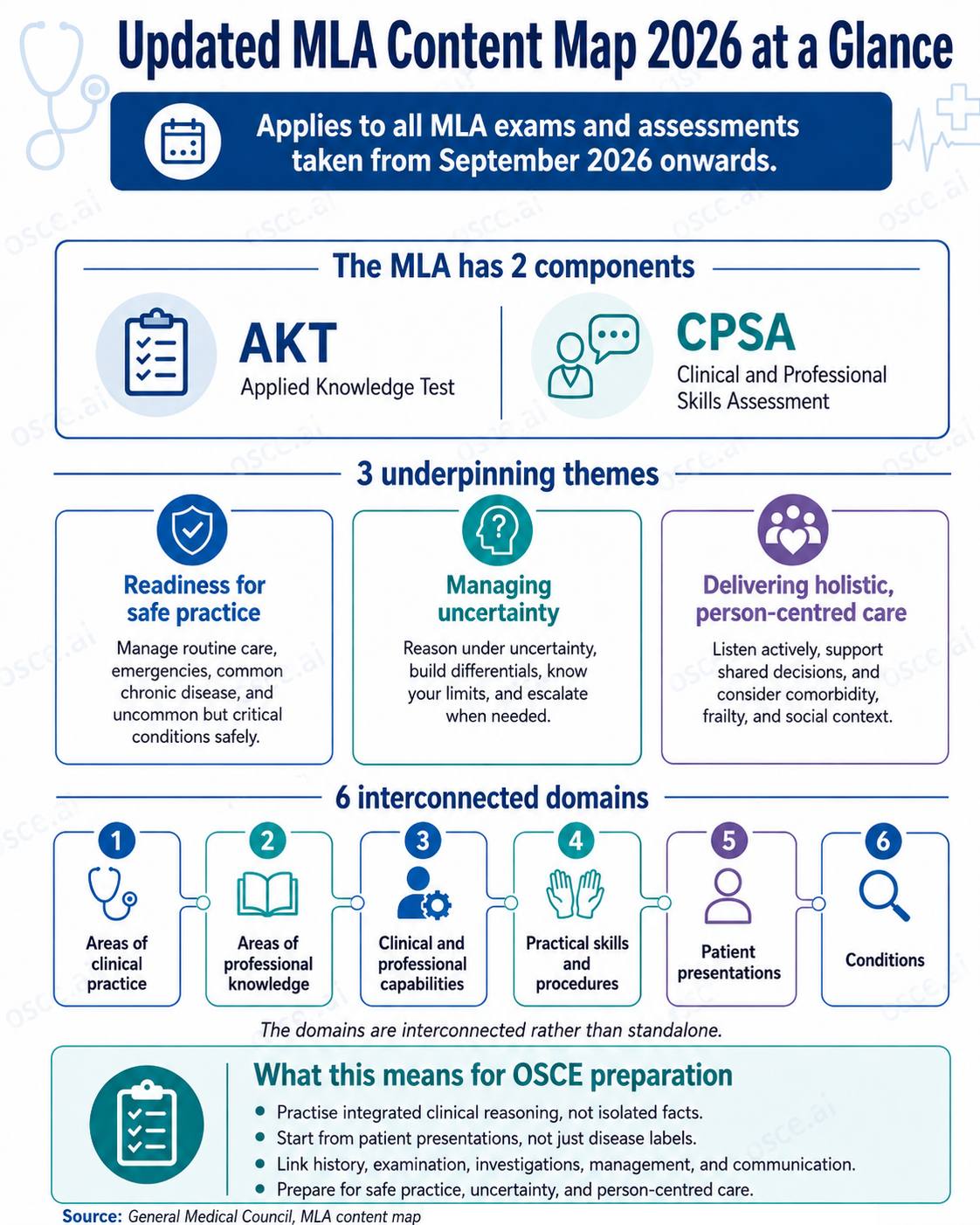
The updated Medical Licensing Assessment (MLA) content map applies to all MLA exams and assessments taken from September 2026 onwards. For medical students preparing for clinical assessments, the update matters because it reinforces something that good OSCE preparation has always required: knowing the medicine is not enough. You need to apply it safely, reason through uncertainty, communicate effectively and manage the patient in front of you.
Looking for the official MLA resources? We’ve linked the GMC’s full 53-page content map (PDF) and domains spreadsheet (Excel) at the end of this guide.Jump to downloads ↓
The General Medical Council (GMC) published the updated map in October 2025. It applies to all MLA exams and assessments taken from September 2026 onwards.
The MLA consists of two components: the Applied Knowledge Test (AKT) and the Clinical and Professional Skills Assessment (CPSA). The content map provides the framework for both. The GMC also notes that the content map does not fully replicate all Outcomes for graduates, because some aspects cannot be assessed through the AKT or CPSA.
For students practising OSCE stations, however, the most important question is not simply “What topics are listed?” It is:
How should the new map change the way you practise clinical scenarios?
Quick answer: what should OSCE students notice in the September 2026 MLA content map?
The September 2026 map is organised into six interconnected domains and is framed by three underpinning themes: readiness for safe practice, managing uncertainty and delivering holistic, person-centred care.
The six domains are:
- Areas of clinical practice
- Areas of professional knowledge
- Clinical and professional capabilities
- Practical skills and procedures
- Patient presentations
- Conditions
The GMC stresses that these domains are interconnected rather than standalone. In other words, preparation should not become six separate revision checklists. A clinical problem can require knowledge, communication, examination, clinical reasoning, investigation, management and professional judgement at the same time.
For OSCE students, the most important features and emphases are:
- the three underpinning themes of readiness for safe practice, managing uncertainty and holistic, person-centred care
- interconnection across all six domains, rather than treating them as standalone revision silos
- explicit links to Good medical practice and other relevant GMC professional and education guidance
- the explicit inclusion of clinical imaging in Domain 2, including selecting appropriate investigations for common conditions and diseases
- detailed coverage of areas including human factors and quality improvement, microbiology, medical ethics and law, and social and population health
- Domain 3 organised around professional skills and professional values and behaviours
- the GMC statement that Domains 3 and 4 are particularly relevant to CPSAs
- Domain 5’s requirement for structured and broad differential diagnoses, including conditions not individually listed in the content map
- Domain 6’s clear statement that the conditions list is not exhaustive and highlights core conditions, including uncommon but critical illness requiring urgent recognition and escalation.
Those final points are especially important for how students approach OSCE stations: the map rewards adaptable clinical reasoning, not isolated recall.
From the content map to clinical practice
Knowing what to revise is only the first step.
OSCEs test whether you can apply your knowledge in a clinical scenario — from gathering information and examining the patient to prioritising differentials and deciding what to do next. Practice realistic OSCE stations on OSCE.ai and get structured feedback on your performance.
Practice OSCE stations free →The three themes behind the updated MLA content map
Before working through individual domains, understand the three ideas running through the entire map.
1. Readiness for safe practice
Candidates should be able to manage routine problems, emergencies and acute illness, common chronic disease, and less common but critical conditions safely.
2. Managing uncertainty
Medicine rarely presents as a perfectly labelled textbook diagnosis. Candidates need to reason when information is incomplete, construct appropriate differential diagnoses, recognise their limitations, seek help and escalate when necessary.
3. Delivering holistic, person-centred care
Clinical competence includes listening to patients, supporting shared decision-making and understanding how comorbidity, frailty and social circumstances affect care. It also includes working effectively with multidisciplinary teams.
These themes are explicitly identified by the GMC as underpinning the new content map.
For OSCE preparation, that suggests a useful shift in mindset:
Don’t practise a station merely to reproduce a sequence. Practise it to manage a patient.
The six MLA domains — and what they mean for OSCE stations
Domain 1: Areas of clinical practice
Domain 1 describes the contexts in which care is delivered. It spans a broad range of specialties, systems and patient groups, including acute and emergency care, cardiovascular medicine, child health, dermatology, mental health, neurosciences, obstetrics and gynaecology, respiratory medicine, surgery and many others.
The GMC explains that these should not be treated as rigid specialty silos. The domain reflects the complexity of real clinical care and the range of situations encountered in the UK Foundation Programme.
For students, this means your bank of OSCE stations should also be broad.
You should be comfortable moving between very different clinical contexts: an acutely deteriorating patient, a cardiovascular examination, a neurological presentation, a mental-health consultation, a paediatric history or a conversation involving palliative care.
If physical examination stations are an area you need to strengthen, our Cardiovascular Examination OSCE Guide and Neurological Examination OSCE Guide provide structured approaches to two high-yield examination areas.
Domain 2: Areas of professional knowledge
Domain 2 covers the knowledge that underpins clinical decision-making.
It includes allergy and immunology, biomedical sciences, clinical biochemistry, clinical imaging, clinical pharmacology and therapeutics, genetics and genomics, histopathology, human factors and quality improvement, laboratory haematology, medical ethics and law, microbiology, psychological principles, and social and population health.
A notable feature is the explicit inclusion of clinical imaging. The map includes not simply knowledge of imaging but understanding how to select appropriate investigations for common clinical conditions and diseases.
This has a practical implication for OSCE preparation.
A candidate who reaches the correct diagnosis but cannot choose an appropriate investigation—or requests investigations indiscriminately—has not demonstrated complete clinical reasoning.
When practising a station, therefore, don’t stop at:
“What is the diagnosis?”
Continue:
“What investigation would I request, why am I requesting it, what might it show, and how would the result change management?”
Domain 3: Clinical and professional capabilities
For students preparing for OSCE stations, Domain 3 deserves particular attention.
The domain covers the skills, behaviours and attributes required for safe, effective and compassionate patient care. The GMC specifically includes clinical reasoning, communication, teamwork, leadership, ethical decision-making and reflective practice within these capabilities.
One of its core capabilities is obtaining and evaluating relevant patient information through an appropriate history and physical and/or mental-health examination, then producing a prioritised problem list and differential diagnosis.
But the domain goes much further.
Candidates are also expected to:
- identify and request appropriate investigations
- interpret and act on results
- avoid over-investigation, over-diagnosis and over-prescribing
- develop management plans for emergency and acute presentations, chronic conditions, and health promotion and disease prevention
- communicate effectively with patients, relatives, partners, carers and other advocates, including adapting communication to individual needs and supporting person-centred decisions
- understand capacity, consent and confidentiality
- prescribe, review, communicate and monitor medicines safely
- perform procedures safely
- safeguard vulnerable patients
- manage complexity and multimorbidity
- recognise when to ask for help
- use evidence and guidelines appropriately.
For example, the updated map explicitly expects doctors to consider contextual factors such as employment, housing, lifestyle, barriers to accessing healthcare and other patient characteristics when gathering information and planning care. It also includes pain management, palliative and end-of-life care, legal and ethical responsibilities, teamwork and leadership, risk management, safe information handling, reflective practice and personal wellbeing.
This is precisely why memorising OSCE scripts can become limiting.
A strong station performance requires a flexible clinical framework, not a speech learned word-for-word.
Domain 4: Practical skills and procedures
Domain 4 supplements Outcomes for graduates and specifies the practical skills, procedures and levels of competence newly qualified doctors must achieve to practise safely when they begin work.
Importantly, the GMC specifically states that Domain 4, together with Domain 3, is particularly relevant to CPSAs.
That makes practical performance an essential component of preparation.
Knowing the steps of a procedure from a textbook is different from being able to perform or explain it safely under assessment conditions while maintaining communication, infection control, consent, patient comfort and appropriate clinical judgement.
Your practice should therefore combine knowledge retrieval with actual performance wherever possible.
Domain 5: Patient presentations
This may be the domain that most naturally translates into realistic OSCE stations.
Domain 5 is organised around signs, symptoms, investigation results and other patient-related issues commonly encountered in the UK Foundation Programme.
Examples include:
- abdominal pain
- abnormal vaginal bleeding
- anaemia
- breathlessness
- chest pain
- confusion
- deteriorating patient
- dizziness
- jaundice
- limb weakness
- lymphadenopathy
- memory loss
- pain management (acute and chronic)
- suicidal thoughts
- urinary symptoms
- vision change/loss (acute and gradual)
- vomiting
- weight loss.
The GMC explicitly says candidates should develop structured and broad differential diagnoses and recognise that patients may have several concurrent problems. Comorbidity may alter the presentation, patients may describe symptoms in their own words rather than predefined labels, and some may present without any apparent signs or symptoms of disease.
That is an excellent model for OSCE practice.
Instead of revising only:
“Acute coronary syndrome station”
practise:
“A 58-year-old presents with chest discomfort.”
Now you have to gather information, recognise red flags, interpret findings, construct and prioritise a differential, choose investigations and decide what needs to happen next.
That is much closer to real clinical reasoning.
Domain 6: Conditions
Domain 6 outlines the pathophysiological diseases and clinical diagnoses candidates are expected to understand at the level expected of a doctor in training in the UK Foundation Programme.
The list is not exhaustive. It identifies core conditions: some are common and form the foundation of everyday practice, while others are rare but critical and require urgent recognition and intervention to prevent harm.
Candidates are expected to recognise that conditions evolve over time, so early-stage presentations may differ substantially from later presentations or complications.
They should identify key clinical features and red flags, recognise serious illness in time to escalate care, and interpret the condition in the context of epidemiology, risk factors and comorbidities.
For OSCE practice, that shifts the useful question from simple recall toward recognition, prioritisation and safe action.
Rather than asking:
“Have I memorised this disease?”
ask:
“Could I recognise this disease when it presents imperfectly—and distinguish it from dangerous alternatives?”
That is a much more useful question for an OSCE station.
| MLA domain | In practical terms | What to practise in OSCE stations |
|---|---|---|
| 1. Areas of clinical practice | Different specialties, patient groups and clinical settings | A broad range of acute, chronic, paediatric, mental-health, surgical and other stations |
| 2. Areas of professional knowledge | Scientific, clinical, ethical and social knowledge underlying decisions | Investigation selection, pharmacology, imaging, ethics and application of knowledge |
| 3. Clinical and professional capabilities | Clinical reasoning, communication and professional behaviour | History, examination, differentials, management, consent, communication, safeguarding and escalation |
| 4. Practical skills and procedures | Safe practical competence | Performing/explaining procedures with consent, communication and safety |
| 5. Patient presentations | The problem as the patient actually presents it | Presentation-led stations such as chest pain, breathlessness, dizziness or confusion |
| 6. Conditions | Core diseases and diagnoses | Recognition, red flags, differentials and appropriate management rather than disease-name recall alone |
What does the updated MLA content map mean for your OSCE preparation?
The map points toward an integrated approach to clinical practice.
Consider chest pain.
You could connect:
Clinical practice → cardiovascular / acute and emergency care
Professional knowledge → anatomy, physiology, pharmacology and imaging
Capability → history, examination, clinical reasoning, communication and management
Practical skills → relevant examination/procedural competencies
Presentation → chest pain
Conditions → acute coronary syndrome and competing diagnoses
The GMC itself uses acute coronary syndromes to illustrate this interconnected approach: candidates should understand the underlying anatomy, interpret clinical findings in context and formulate a prioritised differential diagnosis to guide management.
This is also a useful blueprint for constructing your own OSCE practice.
A well-designed station should force you to connect multiple domains rather than demonstrate one isolated fact.
A better way to practise OSCE stations for the 2026 MLA framework
A useful station-based revision cycle is:
PresentationHistoryExaminationDifferential diagnosisInvestigationsManagementCommunicationFeedbackTargeted revision
Suppose your starting presentation is breathlessness.
Don’t simply memorise the respiratory history checklist.
Take the history. Identify immediately dangerous possibilities. Decide which examination findings you need. Construct a prioritised differential. Select investigations. Interpret the information available. Explain your reasoning. Develop an appropriate management plan. Communicate it to the patient.
Then review what you missed.
This approach also makes OSCE mark schemes more useful. Instead of treating a mark scheme as something to memorise, use it to identify recurrent performance gaps.
If you are still developing a repeatable structure for stations, our OSCE Template for Medical Students explains how to organise your approach without turning every consultation into a rigid script.
How OSCE.ai can support this style of preparation
The updated MLA map repeatedly emphasises application, clinical reasoning, uncertainty, patient-centred communication and connections across domains.
Those skills are difficult to develop through passive reading alone.
OSCE.ai is designed around active clinical practice. Students can work through realistic OSCE scenarios rather than simply reading model answers.
Its learning resources include OSCE stations informed by real patient cases, established medical references, textbooks and research literature, allowing students to practise moving from presentation to clinical decision-making.
Depending on the activity, preparation can involve:
- interactive clinical stations
- history taking and patient communication
- physical-examination decision-making
- prioritising differential diagnoses
- selecting investigations and management
- real-time feedback
- question banks
- flashcards and targeted revision
- performance feedback and analytics
- peer practice and simultaneous communication/practice features.
This matters because a good OSCE learning system should not simply tell you that “chest pain can be ACS.”
It should make you decide which questions to ask, what findings matter, what dangerous alternatives must remain in your differential, what you should investigate, what you should do next and how you communicate that plan safely to the patient.
That is much closer to the integrated reasoning emphasised in the updated MLA content map.
For students who want to practise away from a conventional study desk, our guide to building a portable OSCE practice setup also explains how to make repeated station practice easier to fit into everyday revision.
And if you’re interested in why we built OSCE.ai around active clinical practice rather than passive memorisation, read Why I Helped Build OSCE.ai.
Don’t turn the new MLA content map into another checklist
Perhaps the biggest mistake students could make is treating the new map as a closed checklist and attempting to tick off hundreds of entries one by one.
The framework gives you good reasons not to do that.
The six domains are interconnected. Patient presentations may be ambiguous. Patients can have several conditions simultaneously. The conditions list is not exhaustive. Candidates need to manage uncertainty rather than simply recognise memorised patterns.
So use the content map as a framework for constructing clinical practice, not merely as a list of facts.
For each important presentation, ask yourself:
- Can I take a focused history?
- Can I perform or select the appropriate examination?
- Can I recognise red flags?
- Can I create and prioritise a differential diagnosis?
- Can I choose appropriate investigations without over-investigating?
- Can I formulate a safe management plan?
- Can I explain that plan clearly and compassionately?
- Do I know when I need senior help or escalation?
If the answer to one of those questions is no, you have found a useful revision target.
Updated MLA content map 2026: key takeaway
The updated MLA content map makes the fundamentals of good clinical-exam preparation explicit.
From September 2026 onwards, the framework places clear emphasis on safe practice, uncertainty, person-centred care, clinical reasoning and the integration of knowledge with professional behaviour.
For students preparing through OSCE stations, that means the goal should not be to memorise the “perfect station.”
The goal is to become capable of meeting an unfamiliar patient, gathering the right information, recognising what matters, reasoning safely, communicating effectively and making an appropriate clinical plan.
That is a harder skill to build than memorising a checklist.
It is also much closer to being ready for clinical practice.
Frequently Asked Questions
When does the updated MLA content map take effect?
The updated MLA content map applies to all MLA exams and assessments taken from September 2026 onwards. For an assessment before that date, use the GMC content map applicable to your exam date.
What are the six domains of the updated MLA content map?
They are Areas of clinical practice; Areas of professional knowledge; Clinical and professional capabilities; Practical skills and procedures; Patient presentations; and Conditions. The GMC states that these domains should be considered together rather than as isolated categories.
What should I focus on in the updated MLA content map for 2026?
Focus on the three underpinning themes—readiness for safe practice, managing uncertainty and holistic, person-centred care—and on connecting the six domains rather than revising them in isolation. For clinical assessments, Domain 3 and Domain 4 are especially relevant to CPSAs, while Domain 5 emphasises broad differentials and Domain 6 makes clear that its conditions list is not exhaustive.
Is the MLA CPSA an OSCE?
The content map itself does not define the CPSA as an OSCE or prescribe a single station format. It identifies the CPSA as the clinical and professional skills component of the MLA and states that Domains 3 and 4 are particularly relevant to CPSAs. For the exact format of your clinical assessment, follow the guidance from your medical school or assessment provider.
Are OSCE stations useful for MLA CPSA preparation?
OSCE stations can be useful when they practise the same capabilities that the content map makes relevant to CPSAs: history taking, physical and/or mental-health examination, clinical reasoning, communication, safe management, professionalism and practical skills. The updated content map specifically states that Domain 3 (Clinical and professional capabilities) and Domain 4 (Practical skills and procedures) are particularly relevant to CPSAs.
Should I memorise every condition in the updated MLA content map?
No. The GMC says the conditions list is not exhaustive and identifies core conditions. Domain 5 also expects candidates to build broad differentials that can include conditions not individually listed in the content map. Your preparation should therefore focus on recognising presentations, prioritising differentials, identifying red flags and making safe decisions—not on treating the list as a finite syllabus to memorise.
What is the best way to practise OSCE stations?
Use repeated, timed practice that connects the whole clinical pathway: patient presentation, focused history, relevant examination, prioritised differential diagnosis, investigations, management and communication. Follow each station with feedback and targeted revision rather than simply repeating a memorised script.
Official source
Download the official GMC content map files
For the full framework and structured domain lists, use the GMC source files below.
For the definitive framework, students should always consult the GMC’s Updated MLA Content Map (applies from September 2026). The GMC describes the content map as the framework underlying both the AKT and CPSA.